If you’re even a little bit into competitive shooters, then sooner or later the idea of an aim trainer comes naturally. Aim Lab, Kovaak’s are familiar names that pop up in guides, on forums, and in conversations with teammates. These tools promise to improve the scope: teach stable tracking, sharp flicks and confident shooting in stressful situations. And, importantly, many players confirm that it really works. Regular training gradually builds muscle memory and makes shooting noticeably more stable.
In many popular games, to be honest, you don’t shoot that often. In Apex Legends or Warzone, most of the match is spent on loot, running around the map and rare shootouts, which usually start unexpectedly — the enemy jumps out from around the corner or sits in ambush. Aim trainers are solving this problem: they allow you to go in at any time and “get your hands full” on short, repeatable exercises. But then a logical question arises — which aim trainer is better? Below we will analyze Aim Lab and Kovaak’s and try to understand who each of them is suitable for.
Table of Contents
What is the difference between Aim Lab and Kovaak’s
Content
If you evaluate it purely by the amount of content, Kovaak’s is definitely ahead of the pack. More than 15,500 scenarios created by players is an impressive figure, and it continues to grow. In fact, here you can find training for almost any task and any style of play. Do you want to shoot for Cole Cassidy (former Jesse McCree) against various Overwatch heroes? Or work out the Genji, Tracer, and Headlights movie in the McCoy 1v1 scenario? Kovaak’s has had it for a long time. This choice gives you a sense of freedom and fine-tuning your workouts for yourself.

Aim Lab is slightly behind in terms of number — about 12,000 tasks. But in practice, this is enough with my head. The content covers all the key aspects of AIM and is suitable for both beginners and experienced players. However, if you mostly play Apex Legends or Halo Infinite and are looking for scenarios with an emphasis on verticality and distinctive game mechanics, kovaak’s may be a more accurate hit.
As a result, both coaches provide full-fledged tools for the development of AIM. It’s just that one relies on scale and diversity, while the other relies on structure and accessibility.
Integration with games
Kovaak’s and Aim Lab’s approaches are markedly different. Kovaak’s lives off the community: it is the active users who create the lion’s share of the content. Thanks to this, the library is constantly being updated, and you can find a suitable scenario for any task. If you want to simulate the movements of Overwatch heroes or specific duels, please, there are plenty of options.
Aim Lab is following a different path and actively cooperates with major studios. Partnerships with Riot Games and Ubisoft have allowed the addition of official training sessions for Valorant and Rainbow Six Siege. These are not just abstract shooting galleries, but tasks that repeat real maps and situations. For Valorant players, it’s an opportunity to practice entry—kills on Ascent, and for R6 fans, it’s an opportunity to train their reactions to small and sudden targets. This approach makes the training as close as possible to the real gameplay.
Separately, it is worth mentioning the tasks inspired by the Valorant Champions Tour 2021. Aim Lab recreated the key moments of the tournament in the form of seven special scenarios. You can literally repeat the highlights of the professionals. Yes, this is more of a fan service for Valorant fans, and such tasks are not always useful in the universal aim upgrade, but they look impressive.

Plus, Aim Lab allows you to link a Riot Games account. This opens up access to personalized Player Cards, which display accuracy, speed, reaction, and tracking metrics. It also indicates the rank in Valorant and the main agent. It’s a small thing, but it’s nice — progress becomes visible.
Bottom line: Kovaak’s takes advantage of quantity and flexibility, Aim Lab takes advantage of official integrations and close ties to specific games.
Statistics
Both aim trainers are not limited to just shooting – after each task you get detailed statistics. In Kovaak’s, everything is pretty straightforward and clear: damage, accuracy, final score, comparison with previous attempts. Plus, there is a leaderboard that adds excitement and a desire to improve the result.
Aim Lab approaches analytics more technologically. AI analysis is used here, and the results are displayed as a visual hexagon. It evaluates several parameters at once: total score, number of kills, percentage of hits, time to kill, kills per second and accuracy. One look and it’s already clear where everything is fine and where there are problems.

The Insights tab deserves special attention. She takes your shooting to pieces and directly points out your strengths and weaknesses. For example, the system may notice that you have excellent horizontal control of the scope, but you often miss targets at the bottom of the screen. And then he offers specific tips: check if there is enough room for the mouse to move, or pay attention to the grip. This approach makes training more meaningful.
However, over time, these hints begin to repeat themselves. When basic mistakes are fixed, the value of advice decreases. Nevertheless, both Aim Lab and Kovaak’s provide enough information to track progress and understand what to work on next.
User Interface
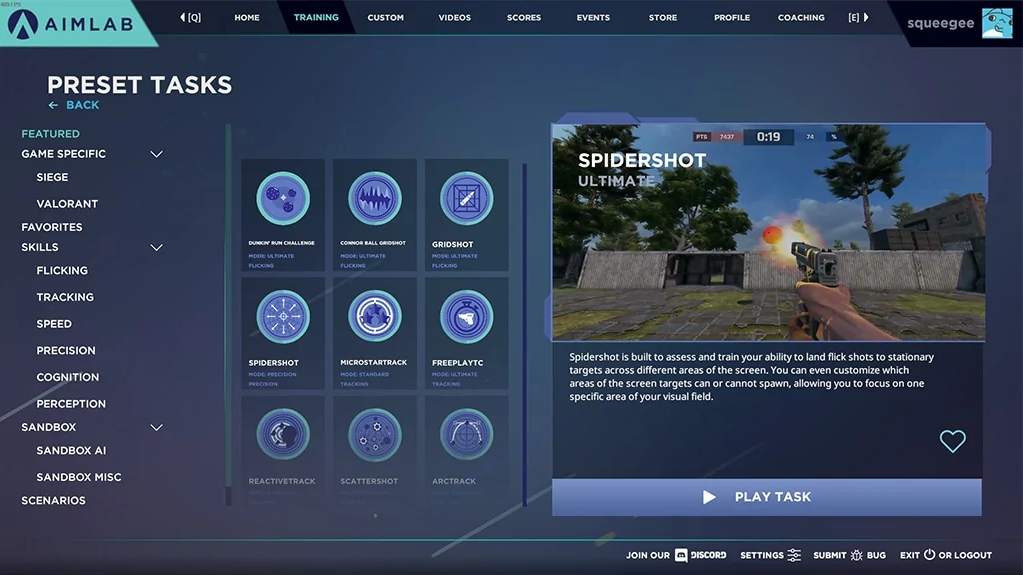
In terms of convenience, Aim Lab is noticeably winning. The interface here is neat and logical: the tasks are divided into categories — clicks, tracking, speed, accuracy, cognitive skills, perception. It’s easy to find exactly what you need. Plus, each task has a preview, so you know in advance what you’re going to play.
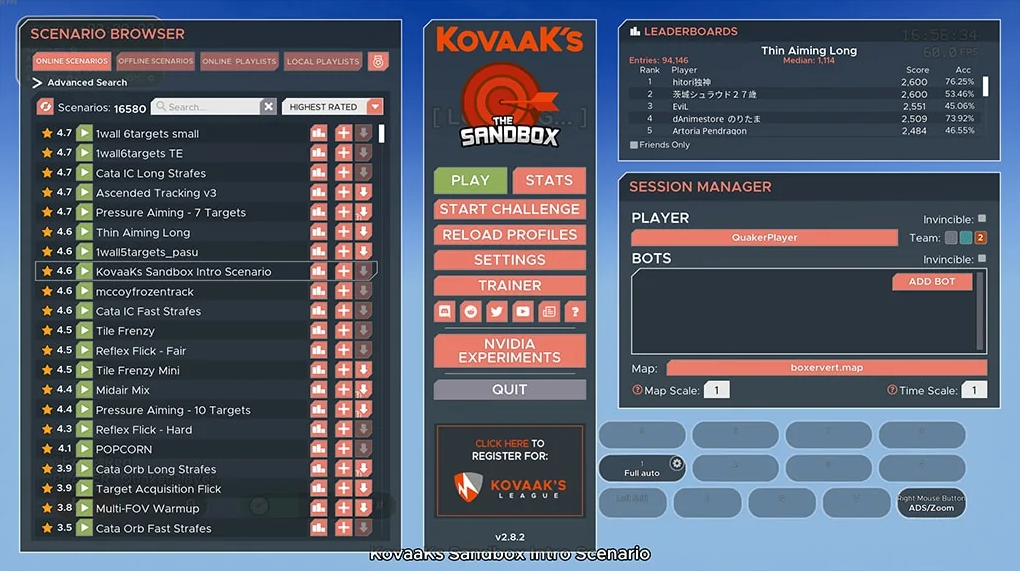
Everything is different at Kovaak’s. The main focus is on the scale of the library. In the script browser, you are greeted by a long list of tasks with stellar popularity ratings. But names like “Cata IC Long Strafes” or “POPCORN” often don’t mean anything, especially if you’re just starting out.
When you hover over it, you can see a brief description and the game that the script was created for. However, due to user—generated content, these descriptions can be of varying quality – sometimes useful, sometimes almost useless. Therefore, beginners often have to look for additional guides outside of the program itself. One of the most popular options is a guide from Aimer7 with ready—made training routines for levels from “complete beginner” to “aim beast”.
To sum up: Aim Lab offers a friendly interface and intuitive navigation, while Kovaak’s offers a huge selection and deep customization, but with a slightly higher entry threshold.
So what should I choose?
If you’re primarily playing Valorant or Rainbow Six Siege, Aim Lab looks especially appealing. He has official integrations with these games and a set of training scenarios tailored specifically to their mechanics. This greatly simplifies the start: you don’t need to figure out what and why for a long time — you start training and immediately work on the aim in a familiar context. In addition, the Aim Lab interface is made as simple and intuitive as possible, without overloaded menus and unnecessary settings, so it’s easy to navigate it even on the first day.
A separate plus is that the Aim Lab is completely free. For beginners who are just getting to know aim trainers and don’t want to spend money right away, this is a weighty argument. You can safely try, get involved in the process and see if this training format is right for you.
By integrating with Valorant and Rainbow Six, Siege Aim Lab provides a focused, “gaming” training experience. You don’t just shoot at abstract targets, but practice situations that actually occur in matches. If your goal is to improve aim in these games or you are just looking for a convenient and friendly launch platform, Aim Lab becomes the logical choice. And the lack of a paid entrance removes any doubts: you can start training immediately, without unnecessary hesitation.