

Sometimes video games surprise not with huge budgets or photorealistic graphics, but with one simple but truly original idea. Crayon Physics Deluxe is just such a project. This is a small indie puzzle game in which the player literally draws the solution to the problem. It all starts with an ordinary piece of paper, a ball, and one small star to reach.
At first glance, it seems that you are looking at something very simple – almost a child’s game. But after a few minutes, it becomes clear that this simplicity hides a surprisingly fascinating system. Any line, circle, or strange shape drawn with the mouse turns into a real physical object. He falls, rolls, collides with other objects and can either help the ball move or completely destroy your plan.
When you first launch Crayon Physics Deluxe, it feels like you’ve opened a school notebook and started drawing in the margins. It’s only here that these drawings suddenly begin to live their own lives. You’ve drawn a circle, and it’s falling. We drew a line — it becomes an inclined surface. And suddenly a simple doodle turns into a working mechanism.
The most pleasant feeling is the moment when your strange, at first glance ridiculous design suddenly works. The ball slowly begins to move, collides with the painted object, which rotates and pushes it further towards the target. And at such moments, you can’t help but catch yourself thinking, “Wow… it really worked out.”
It is this simple, almost childish joy of experimentation that makes the game so memorable.
Table of Contents
Crayon Physics Deluxe Gameplay — How physics and drawing mechanics work
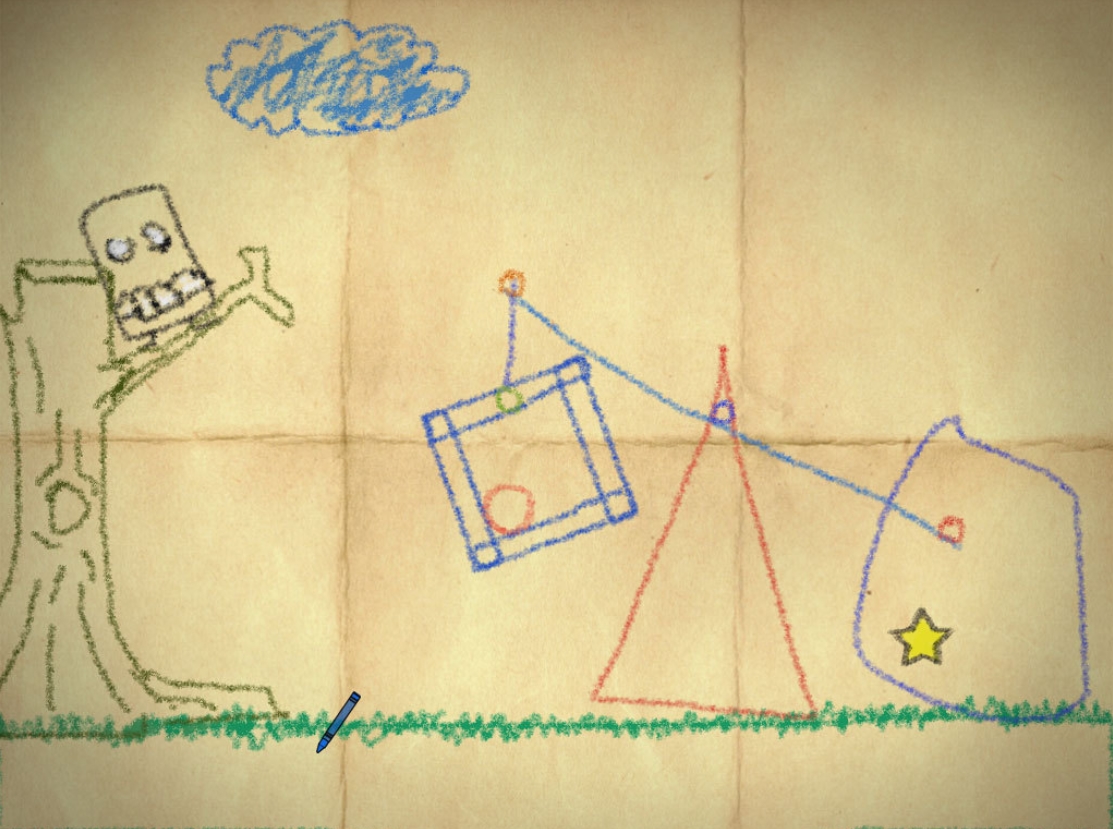
The game is based on one very simple mechanic: if you can draw it, the game will try to turn it into a physical object. And this idea works surprisingly well.
At each level, the player sees a small piece of paper. Somewhere on it there is a ball, and somewhere there is a star. Sometimes there are several stars. The goal is always the same: to make the ball touch the star.
But you can’t control the balloon directly. He just exists in the world and obeys the laws of physics. Therefore, the player has to act differently — to create tools that will make the ball move.
And that’s where the fun begins.
How drawings turn into real objects
Every line you draw immediately becomes part of the game world. The game doesn’t ask what exactly you wanted to portray — it just interprets the shape as a physical object.
The circle begins to roll. The long line turns into a platform. An awkward oval can suddenly become a good counterweight.
It creates a feeling of real freedom. Levels rarely have one strict solution. On the contrary, the game encourages experimentation.
For example, a player can try:
-
draw an inclined path along which the ball will slide smoothly;
-
create a heavy circle that will fall and push the ball;
-
build a kind of catapult;
-
come up with a whole chain of interacting objects.
Sometimes the solution is surprisingly simple. And sometimes you have to draw strange mechanisms that look like real engineering experiments.
The most fun thing is to watch your constructions start moving. Sometimes everything goes perfectly. And sometimes the system falls apart a second after launch, and the balloon does not fly at all to where you planned. But it is precisely such moments that make the game alive.
Explore new releases thanks to your free account in steam.
How does the player control the movement of the ball
The ball itself in the game is more of an observer than a controlled character. He does not jump, does not accelerate on the button and does not react to the player’s commands directly. All he does is react to physics.
Therefore, the player’s task is to create conditions in which the ball will start moving.
Sometimes a little push is enough. Sometimes you need to build a whole chain of events. And it is here that the real charm of the game manifests itself.
You start to think something like this:
-
if this circle falls here, it will push the ball;
-
if the line is slightly longer, the ball will roll faster;
-
if you add another object, you can change the direction of movement.
And at some point, real creative thinking begins. The player stops just solving the puzzle and starts inventing solutions.
I especially remember the moments when the design looks absolutely ridiculous, but it still works. The ball rolls slowly, one object falls on another, something rotates — and suddenly everything adds up to a perfect chain.
Such small wins make the game surprisingly enjoyable.
Levels and Challenges — How puzzles are built in Crayon Physics Deluxe
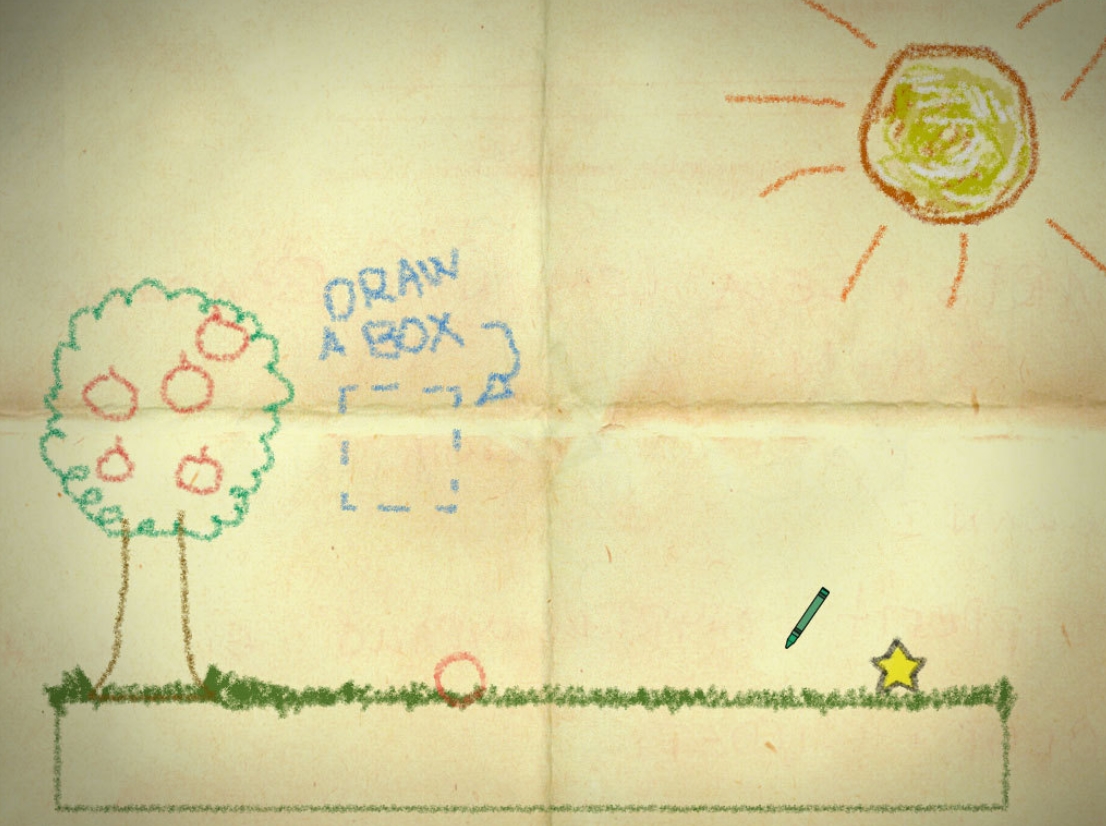
The structure of the levels in the game is quite minimalistic. Each level is a small piece of paper with several elements. No overload of details, no complicated interfaces. Everything is very clean and clear.
And it is precisely because of this simplicity that attention is fully focused on the task at hand.
The first levels serve as a kind of introduction to the mechanics. They show how objects work, how the ball reacts, and what happens when you draw different shapes.
But gradually the game starts to get more complicated.
New situations are emerging:
-
stars located high above the ball;
-
obstacles between the ball and the target;
-
levels where you need to collect several stars;
-
tasks that require consistent actions.
Sometimes it seems that the level is solved too easily. But after just a couple of stages, the game offers a new challenge that makes you think.
And here again, the main advantage of Crayon Physics Deluxe is freedom. You can solve problems the way you want. There is no feeling that the game forces you to use one particular method.
Sometimes you find yourself choosing not the most effective option, but the most interesting one. For example, you build a huge falling structure instead of a simple line, just because you want to see what happens.
And the game does not interfere with such experiments.
Graphics and atmosphere — a world drawn with pencils
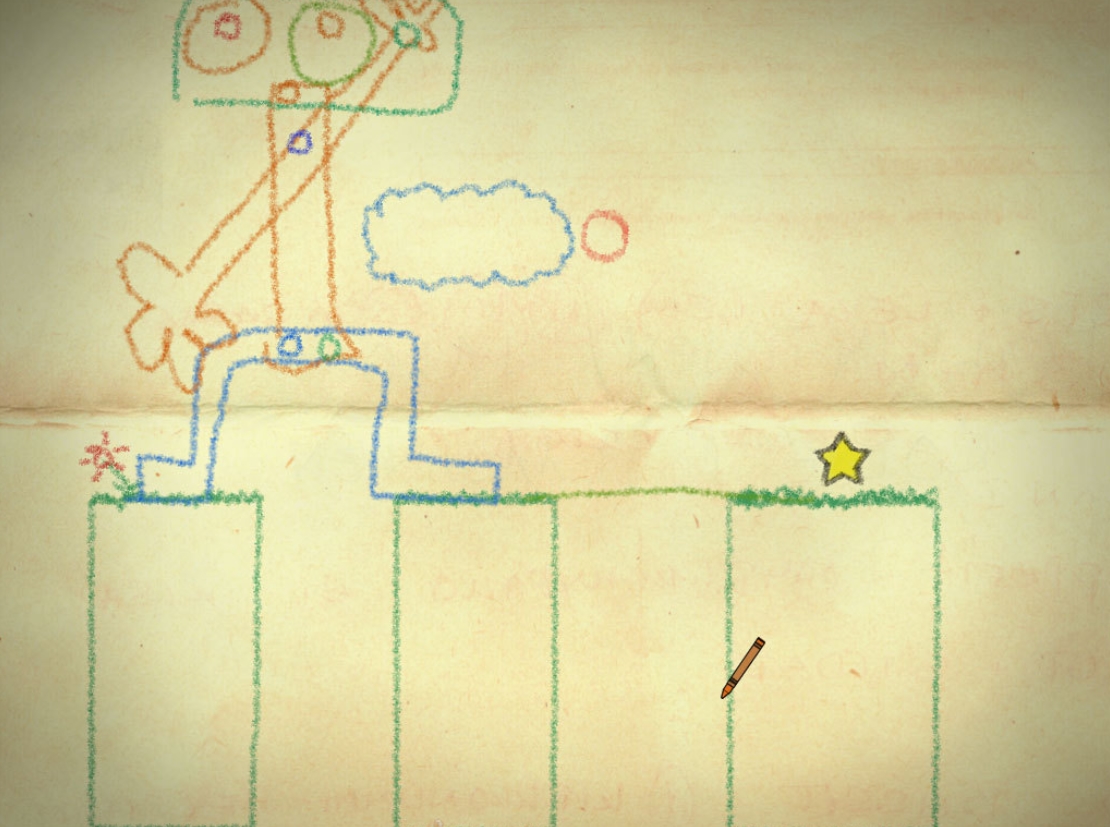
The visual style of Crayon Physics Deluxe cannot be confused with any other game. It looks like someone opened a notebook and started drawing with pencils.
The backgrounds resemble the pages of a notebook, the objects look slightly uneven, and the lines have a characteristic “pencil” texture. Visually, the game seems very simple, but it is this simplicity that makes it so cozy.
It feels like you’re not launching a complex game project, but just sitting at a table and drawing in an album.
The music in the game is calm and soft. She’s not trying to impress or create drama. Rather, she just maintains an atmosphere of relaxed creativity.
Thanks to this, Crayon Physics Deluxe is perceived almost as a calm, creative game in which there is no rush. You can safely experiment, draw, erase and try again.
Sometimes you even find yourself spending more time coming up with funny designs than completing levels.
What makes Crayon Physics Deluxe unique among puzzle games?
There are quite a lot of physics puzzles today. But Crayon Physics Deluxe stands out because of its philosophy.
Most puzzle games give the player a set of tools: buttons, blocks, mechanisms. There is only one tool here — a pencil.
And that’s enough.
There are several things that make the game really special:
-
freedom of decision and lack of a single right way;
-
a sense of creativity rather than rigorous problem solving;
-
a physical system that creates unpredictable situations;
-
a simple idea that is revealed through experiments.
The game doesn’t try to surprise you with its complexity. She is surprised by how interesting it can be to just draw.
Sometimes it seems that the developers have deliberately left room for the player’s imagination. They gave us the basic rules and allowed everyone to create their own solutions.
Is it worth playing Crayon Physics Deluxe today
Despite its age, Crayon Physics Deluxe feels surprisingly fresh. This is a game that is almost independent of technology. Her main idea — creativity through physics — works just as well today as it did many years ago.
Of course, the project is quite small by modern standards. There is no huge amount of content, complex systems, or large-scale levels. But therein lies its special charm.
This is a game that you can return to for half an hour in the evening, solve a couple of tasks and just relax.
It is great for those who like unusual puzzles, appreciate original ideas in indie games, or just want to try something different from standard projects.
Crayon Physics Deluxe is a reminder that sometimes one really interesting idea is enough for a good game. A pencil, a piece of paper and a little imagination — and you already have a whole world of small physical experiments in front of you.
Crayon Physics Deluxe System Requirements for PC
| System Component | Minimum Requirements | Recommended Setup |
|---|---|---|
| Operating System | Microsoft Windows XP or Windows Vista | Windows 7 / Windows 10 |
| CPU | 1 GHz single-core processor | 1.5 GHz or faster processor |
| Graphics | 3D graphics accelerator with 128 MB texture memory | Dedicated GPU with 256 MB video memory |
| RAM | 512 MB system memory | 1 GB RAM |
| DirectX | DirectX 9.0c compatible | DirectX 9.0c or newer |
| Sound | 16-bit compatible sound card | DirectX compatible audio device |
| Storage | 50 MB available disk space | 100 MB free space recommended |
How to play Crayon Physics Deluxe for free on Steam via VpeSports
Sometimes the most interesting games look as simple as possible. Crayon Physics Deluxe is just one of those. At first glance, everything looks almost like a notebook and pencil, but after a couple of minutes it becomes clear that behind this simplicity there is a whole physical sandbox. Everything you draw immediately begins to live according to the laws of physics: lines fall, circles roll, and a random sketch can suddenly turn into a mechanism that solves a puzzle. That’s the main pleasure — trying different ideas, sometimes making mistakes, sometimes finding a solution in just one line and catching the very moment when the star finally finds itself in the right place.
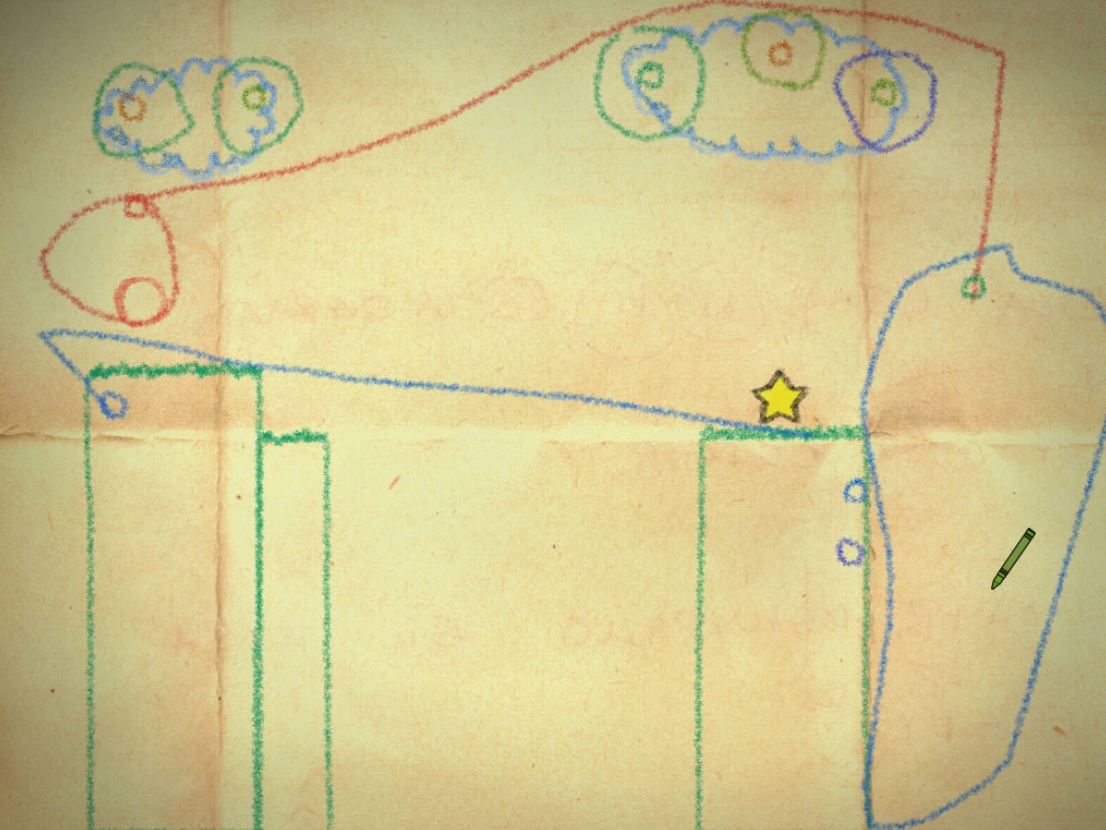
So that you can jump straight into the game, we have tried to remove all unnecessary things from the access process. After registering on the website and logging in to your account, simply return to the top of the page and click GET AN ACCOUNT. Then everything will be clear in steps — the system will show you how to get an account with Crayon Physics Deluxe. We have specially made the process as simple as possible so that you don’t waste time on unnecessary settings and can immediately start working on levels and your experiments with physics.
If you want to keep an eye on new giveaways, updates, and just keep up to date with what’s going on, you can check out our Telegram channel. There are fresh accounts, news, and discussions where players sometimes share quite inventive ways to complete levels. And if something turns out to be unclear or difficulties arise, it is worth looking at the “How to Play for Free — Complete Guide” section. The main points are discussed in detail there. And, of course, you can always write to the chat — they usually respond quickly and help you figure it out.