
Windrose is a brutal trial, especially for solo players or small groups. Once you reach the Cursed Marshes, the gloves truly come off. The combat system follows the classic Soulslike blueprint: every point of stamina counts, positioning is everything, and parrying must be frame-perfect. One mistake, and you’re punished severely.
To survive, you need more than just skill—you need the right gear. Hunting for the best weapons is the only way to purge the Plague from the region and eventually take down the final boss. Your choice of steel dictates your entire build: whether you’re a twitchy striker with lightning-fast attacks, a heavy tank relying on single-hit heals, or a high-dexterity survivalist.
Table of Contents
Best Weapons in Windrose: Where to Start Your Progression
What follows is a breakdown of the most viable gear currently in the game. Good news: one of these is a guaranteed drop. We’ll start there.
First, a critical note on rarity. There is a massive gulf between Common and Rare weapons. Rare items come with built-in unique effects. However, once you ascend a weapon to Epic rarity, you unlock secondary abilities and see a massive spike in stat scaling. This is easily the most significant power jump in the game.

(Note: We are strictly covering melee here. Ranged weapons and bows are a different beast entirely.)
Stat Scaling: Strength, Dexterity, and Precision
-
Strength — The go-to for heavy hitters like halberds.
-
Dexterity — Essential for fast blades and high-frequency combos.
-
Precision — Drives piercing and long-range melee weapons.
Mastery is a specialized stat. While it doesn’t boost raw weapon damage directly, it increases critical strike chance. It’s a valuable investment for almost any build looking to optimize DPS.
Fortunately, Windrose offers several specimens that genuinely make life easier. Below, we’ll break down their unique skills, base stats, and crafting recipes. Remember: even a mediocre drop can be turned into a killing machine through rarity upgrades.
Weapon Upgrades Over Stat Dumping: The Windrose Meta
Flashy ATK numbers in the item card are great for ego, but they don’t tell the whole story. The real impact is hidden in the bottom line, where specific damage types—Slashing, Piercing, or Blunt—are listed. This value (effectively your DPH, or Damage Per Hit) determines how your stats scale and how hard your crits actually land. Furthermore, enemy level is a hard gate. Facing an enemy just one level above you incurs a -13% penalty to base damage, and this penalty stacks. The verdict is clear: before obsessing over your stat spread, ensure your weapon is leveled for the content you’re tackling. Rarity and level increases offer a higher ROI than shuffling points between stats.

The Soft Cap in Windrose: 20 Points and the Shift to Mastery
The stat system in Windrose is linear only up to a point. Strength, Dexterity, and Precision provide their maximum return on investment until you hit 20 points. Past this threshold, the gain per point drops by roughly 50%—this is the soft cap. Community testing across levels 1–30 confirms that this is the primary pivot point for any optimized build.
-
Up to 20 Points — Maximize your primary stats (STR/DEX/PRE); they work at 100% efficiency here.
-
Post-20 Points — Direct stat investments offer diminishing returns. This is where Mastery starts to shine.
-
Base Crit Above 20% — Once you hit this baseline, Mastery becomes your primary DPS engine, especially if your gear includes additional crit triggers.
Mastery in Windrose: Cracking the Critical Hit Chance Formula
Let’s settle the Mastery debate: it grants a 0.5% crit chance per point, not a damage multiplier. Don’t go in with false expectations. 20 points in Mastery equals a flat +10% probability. Crucially, all crit bonuses in Windrose stack additively. There are no hidden multiplicative mechanics here.
For example, if you have three stacks of “Extermination” from the Executioner (+30%), 20 points in Mastery (+10%), the Greatsword talent (+4%), and a perfect block bonus (+5%), you end up with exactly 49% crit chance. Not a percentage more. This makes the Executioner the gold standard for crit builds—its passive covers a third of your requirements before you even spend a single attribute point. It’s a massive head start for any damage dealer.
Crit Chance Sources
Food and Buffs for Crit Optimization in Windrose
Never ignore consumables; they are often the difference-maker in high-tier content. The standard “Taco,” for instance, grants a temporary +20 Mastery boost, which translates to a +10% crit chance. When clearing mobs with the Executioner, the “3 stacks + Taco” combo pushes your crit rate to levels where Mastery as a permanent stat starts providing massive value. It’s the easiest way to stress-test your build’s efficiency before committing to a costly respec. What’s next? Testing the theory on boss encounters.
Soul Eater in Windrose: Location and Epic Upgrade Path
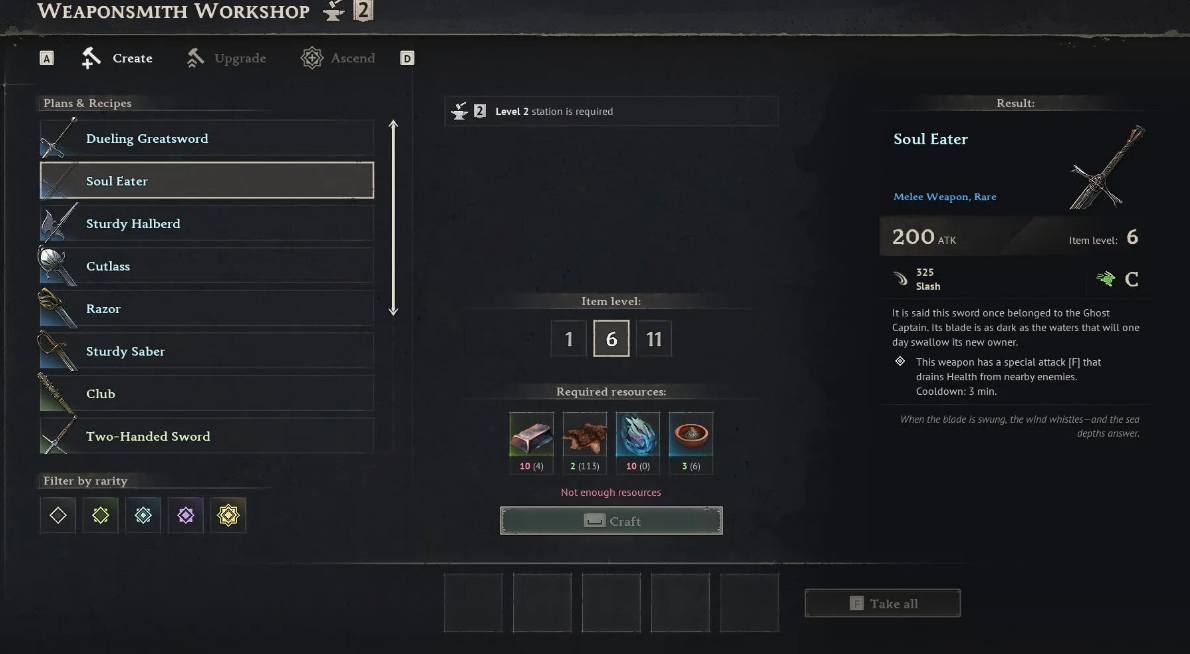
For those who hate RNG, the Soul Eater is a refreshingly predictable drop. It is a guaranteed reward for defeating “The Hands,” the final boss of the Foothills. Some players have also reported drops from the Ghost Captain, suggesting the devs included multiple paths to obtain it.
The weapon is fast and, more importantly, features a life-leech mechanic. Survivability is the name of the game here: if you’re heavily invested in Vitality, the Epic version provides a double-dip benefit—the special attack’s damage begins scaling directly from your Vitality stat. A perfect synergy for bruiser builds.
Base Stats: 325 Slashing Damage.
Skill Evolution by Rarity Tier
-
Rare: Dexterity — C scaling. Special attack leeches HP from nearby enemies. 3-minute cooldown.
-
Epic: Dexterity — B scaling. Adds a second effect: Special attack damage now also scales with Vitality.
Important: The secondary skill doesn’t replace the first; they work in tandem. Upgrading to Epic gives you both perks and superior stat scaling, representing one of the most drastic power spikes in the Windrose arsenal.
Where is the recipe? Once you acquire the weapon for the first time, the blueprint unlocks at the Forge automatically. From there, it’s just a matter of farming resources.
Soul Eater Crafting Recipes by Workbench Level
-
Level 1: 10 Copper Ingots, 2 Raw Hides, 7 Undead Essences. Level 1 Workbench.
-
Level 6: 10 Iron Ingots, 2 Raw Hides, 10 Undead Essences, 3 Blacksmithing Flux. Level 2 Workbench.
-
Level 11: 10 Slough Metal Ingots, 2 Crocodile Hides, 10 Undead Essences, 3 Blacksmithing Flux. Level 3 Workbench.
Pro tip: You’ll need a mountain of Undead Essence. Start stockpiling early.
Executioner vs. Ravage Rapier: Comparing the Top-Tier Blades
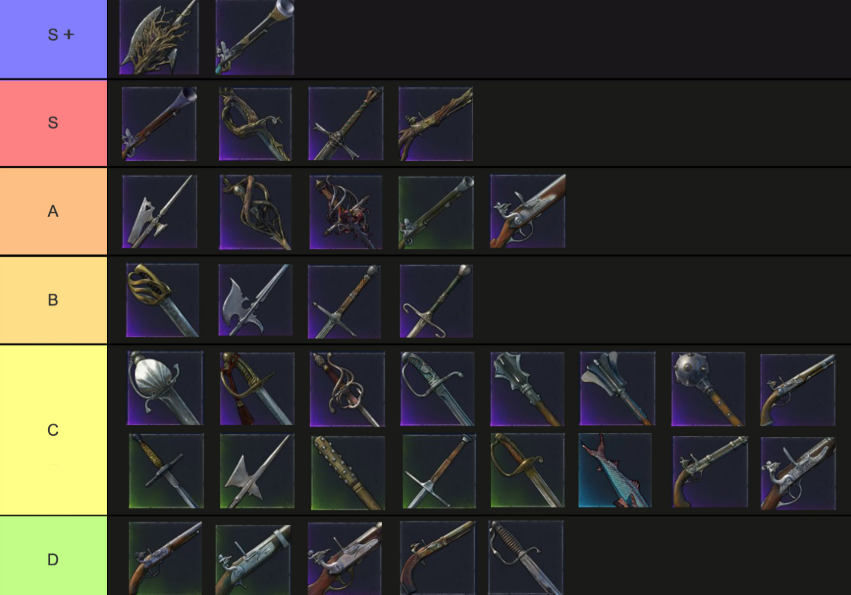
While the Windrose meta is currently in flux, two weapons stand out with a staggering 365 Blunt Damage: the “Executioner” halberd and the “Ravage Rapier.” The former is a Strength-based powerhouse, while the latter offers a more tactical, high-speed approach.
Let’s look at the Executioner. This isn’t a weapon for mindless button-mashing—it’s significantly slower than the Soul Eater or the rapier. But when it connects, it ends fights. The Rare version (STR – C) grants the “Extermination” passive: kills grant stacks that increase crit chance by 10%, capping at 30%. The Epic tier (STR – B) adds “Apathy”—granting +10% damage resistance while Extermination is active. It’s the ultimate tool for front-line brawlers.
Crafting the Executioner is relatively straightforward. Level 1: 10 Wood, 7 Copper Ingots (Level 1 Workbench). Level 6: 12 Hardwood, 5 Iron Ingots, 3 Flux (Level 2). Level 11: 8 Hardwood, 7 Slough Metal Ingots, 3 Flux (Level 3). It’s an investment, but the payoff is massive.
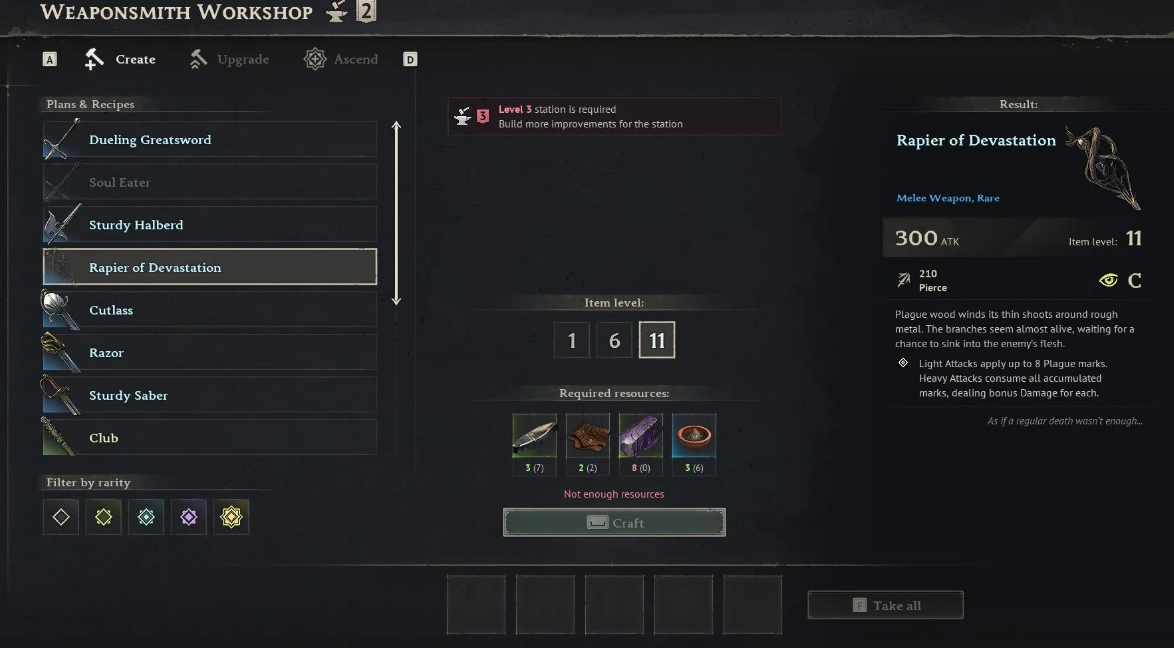
Then there’s the Ravage Rapier. It shares the 365 damage baseline but plays completely differently. Light attacks apply Plague marks (up to 8), and heavy attacks detonate them for explosive burst damage. The Epic variant (STR – B) adds a vital survival perk: if you detonate 5 or more marks at once, you recover 40% health. It’s incredibly resilient gear for high-risk encounters.
Where to find it? Mostly RNG chests, but there’s a lead: many players have found it on a skeleton at the “Ruined Flowerbed” point of interest in the Cursed Marshes. Generally, the Marshes, specifically crypts and garden ruins, have a higher drop rate for high-tier chests.
Crafting Recipes for Executioner and Ravage Rapier
-
Level 1 — 3 Copper Ingots, 2 Raw Hides, 5 Arborum Ingots. Level 1 Workbench.
-
Level 6 — 3 Iron Ingots, 2 Raw Hides, 8 Arborum Ingots, 3 Flux. Level 2 Workbench.
-
Level 11 — 3 Slough Metal Ingots, 2 Crocodile Hides, 8 Arborum Ingots, 3 Flux. Level 3 Workbench.
The Bottom Line? Use the Executioner for high-crit, defensive brawling. Choose the Rapier if you prefer a “dance and heal” playstyle. Both are top-of-class, especially if you’re hitting a wall in the Cursed Marshes.
Plague Halberd in Windrose: Vampirism and AoE Dominance at Epic Tier
Third on our list is the “Plague Halberd.” This is a Strength weapon that doesn’t just shatter bone at the Epic level—it keeps you alive. With 355 Blunt Damage, its raw stats are slightly lower than the Executioner or Rapier, but its unique mechanics change the engagement rules.
At the Rare tier (STR – C), you accumulate “Plague Echoes” stacks with every hit. Upon reaching 5 stacks, you unlock a powerful special attack. At the Epic tier (STR – B), this special attack instantly restores 35% of your health while dealing massive area-of-effect damage. Imagine diving into a pack of mobs, spinning the halberd, and walking out with full health. It’s an essential pick for aggressive players who tend to overextend.
Where to farm? To be honest, drop rates are stingy—I’ve cleared dozens of ruins in the Cursed Marshes without a hit. According to the community, your best bet is farming chests in crypts and garden ruins. These spots have the highest concentration of high-end loot tables.
Don’t get tunnel vision on just one weapon. Windrose has plenty of alternatives—firearms, heavy maces, and more—depending on your style. But if you want a Strength build with built-in vampirism, the Plague Halberd is definitely worth the grind.